

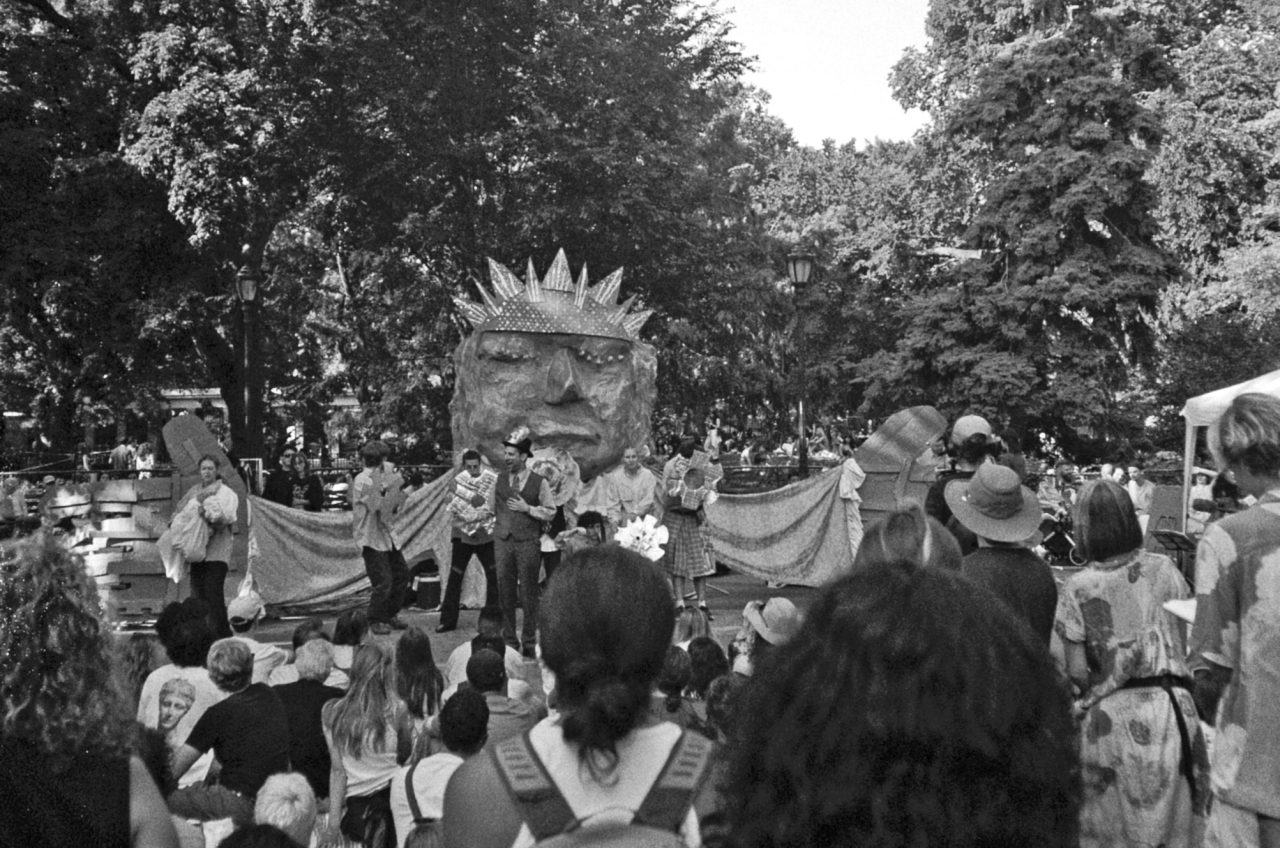
The Luddites see Big Tech as having eroded commonality: the common good, the social fabric, the institutions of collective interest. Luddism, as they conceive of it, is a communal, spiritual, and political project centered on three things: reclaiming collective agency away from Big Tech and its attention-fracking, data-capturing, social erosion project; re-enchanting public life through public events that help people experience connection; and fostering a world rooted in localism, public goods, care, fun, democracy, and what one Luddite I spoke to referred to as “collective effervescence.” Collective effervescence, I suspect, was what I was surprised to encounter in myself that winter day by the Apple Cube. The phrase, first coined by the sociologist Emile Durkheim, refers to the electric and exhilarating energy you might find at raves, protests, marathons, and houses of worship: the feeling you have when you’re connected to something larger than yourself.
The Luddites I met made few direct demands of institutional power. There was no lobbying for antitrust legislation, or for regulating addictive design features and removing ed tech from schools (though a couple of Luddites volunteered for Alex Bores, the New York congressional candidate, and some were tracking the writer Jonathan Haidt’s work around adolescent smartphone use). Unlike their forebears, these Luddites did not advocate for property destruction, save the symbolic iPad at S.H.I.T.P.H.O.N.E. Instead, their focus was on the prefigurative, revolutionary potential of events—specifically free, public, participatory, unpredictable events.
There was a theory of change behind this. Back at S.H.I.T.P.H.O.N.E, someone had handed me a zine titled The Event Is The Medium, a nod to Marshall McLuhan that doubled as a succinct description of the Luddites’ strategy. The event: no tickets, no invitation on social media, no closed guest list, and no promise that things would unfold according to plan. The Luddites ran these events and hoped other people would run their own events, and in doing so, change their own norms around sociality.
The aim was lofty: to undo decades of social conditioning by technology and reorient people toward unmediated, embodied connection. One in-person meet-up at a time, they would inspire people to make tech work for them instead of the other way around.
Luddites didn’t have issues with technology. The issue was how technology was being used to suppress wages and erode labor rights. A modern day Luddite would still have a phone and an email address they just wouldn’t use AI or social media.
Edit: Forgot the source: https://www.smithsonianmag.com/history/what-the-luddites-really-fought-against-264412/